

Managing data center cooling at a solar-powered microgrid site has never been more challenging—and AI is the reason why. It’s a challenge that’s reshaping the entire industry. If you lead a data center, you have probably noticed the shift. For a long time, telecommunications and data organizations didn’t need to worry where power came from or how to keep it cool. But today, two major industry forces are crashing into each other, pushing the industry into a massive AI power-density surge.
Artificial intelligence (AI) programs require massive amounts of power to run, straining local power grids’ ability to meet demand. This has created long queues at grid interconnections, with some sites waiting years for a hookup. To stay on schedule, many companies are building their own behind-the-meter (BTM) generation using solar and batteries.
But when you put high-powered AI gear inside an outdoor microgrid, you get a data center cooling problem that a standard enclosure can’t handle.
What Is the AI Power Density Surge at Solar-Powered Data Centers?
Think of it as a double whammy of heat. In the past, data center racks used a predictable amount of power. Today’s AI programs, though, are making rack density skyrocket. An International Energy Agency (IEA) report estimates that data centers will use twice as much power by the year 2030. This is not just a power problem, though—more power always means more heat.
When you pack power-hungry chips into an outdoor cabinet deployed in full or even partial sunlight, you create a heat loop. Solar inverters get hot, backup batteries get hot, and the AI servers get hottest of all. If you aren’t ready to address the surge, your expensive equipment is going to bake.
So why are so many data centers moving to solar in the first place—and why is it making the heat problem worse?
Why Are Hybrid Solar Data Centers Growing So Fast?
Switching to solar power is usually about saving time. Because of the aforementioned grid bottlenecks, organizations are tired of waiting for local utility companies to meet their needs. Instead, providers are taking matters into their own hands by building their own power systems on-site.
Data center experts say that solar and other green energy will power half of all new data center growth by 2030. The shift to renewable energy is great for the planet, but it means moving sensitive electronics out of a cool room and into the hot sun.
To understand why that matters, it helps to know exactly where all that heat is coming from.
What Are the Main Heat Sources in a Solar-Powered Data Center Microgrid?
In a solar microgrid, heat comes from multiple sources simultaneously. It starts with the AI hardware. New computers are much more powerful than prior models. In fact, a single rack of AI gear today can generate 8 to 10 times as much heat as it did a decade ago.
To put that in perspective, a 100 kW rack creates about as much heat as running 70 hair dryers at full blast inside one small metal cabinet. And major technology companies say these systems are continuing to get hotter every day.
Then there’s the power gear. The inverters that turn sunlight into electricity work very hard and get very warm during peak sun hours. Finally, you have the battery energy storage systems (BESS). If those batteries get too hot while they are charging, they can wear out early or even become dangerous.
Together, these heat sources compound the risk of equipment failures that could lead to lost connections, unplanned downtime, and other profit- and reputation-damaging issues.
What Are the Risks of Poor Data Center Cooling at Solar Microgrid Sites?
The danger is more than just a warning light on a screen. If you don’t properly plan for data center cooling, your AI hardware will eventually slow down. This is called throttling, and it means you are paying for a super-fast computer but getting the speed of an old laptop.
Beyond slow speeds, heat triggers a chain of expensive problems, including shortened component lifespans and skyrocketing cooling bills as the system struggles to keep up. You also risk unplanned downtime when heat causes a system crash. When the system goes down, you lose your connection to your data and your customers. Plus, the U.S. Department of Energy Office of Electricity warns that improper cooling is the main cause of battery failures and serious safety hazards.
The good news is that the right enclosure can address all of these risks before they become problems.
What Should You Look for in a Solar Data Center Enclosure?
To survive the power density surge, your enclosure must be more than just a box—it needs to be a thermally engineered room for your equipment.
Your first goal should be finding a cabinet with smart data center cooling solutions. Not all data center cooling systems are created equal, and the right choice depends on your climate, load density, and site conditions. Air conditioning units are the most common solution and work well in high-heat environments, but they consume significant power and require maintenance. Closed-loop heat exchangers are a more energy-efficient alternative. They transfer heat out of the enclosure without introducing outside air, while keeping dust and moisture out. For the highest-density AI workloads, some sites are beginning to explore liquid cooling options. At American Products, we assess your specific site conditions and recommend the data center cooling technology that balances performance, efficiency, and long-term reliability. Our climate control systems will keep your gear at the perfect temperature, even if it’s 100°F outside.
You also need a tightly sealed cabinet. When you put computers outside of buildings, you have to deal with dust, rain, and bugs. Look for a NEMA 3R or NEMA 4 rating to mitigate ingress. Our AP MiniFort® and AP Freedom™ cabinets, for example, are built to keep the bad stuff out while the cooling systems handle the heat inside.
Standard enclosures are designed to meet general specifications, but hybrid data center microgrid sites are rarely “normal.” Locations often combine unique heat profiles with non-standard equipment footprints that off-the-shelf products can’t fit. A 2025 Forrester report noted that microgrids and data centers are a sustainable duo, but they introduce significant integration complexity. If your layout is complex, American Products’ custom enclosure capabilities are the answer. We can build a solution that perfectly fits your specific equipment and site conditions.
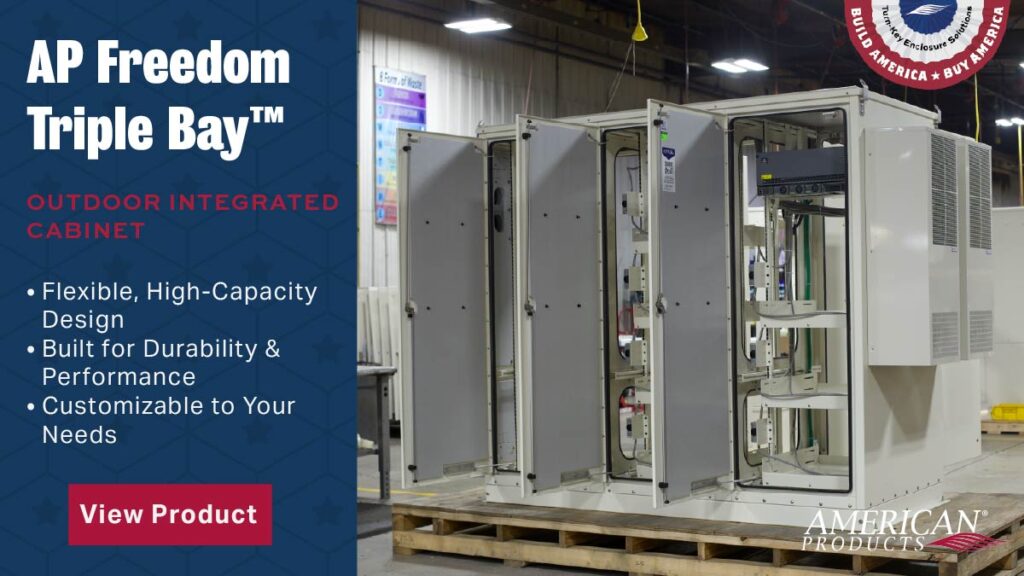
Finally, make sure you have room to grow. Your power needs today will look small in five years. Choosing a modular system like the AP Freedom™ Triple Bay cabinet lets you add more gear later without having to buy a whole new cabinet.
How Do Enclosure Needs Differ for Off-Grid vs. Grid-Tied Solar Microgrid Deployments?
The way you connect power changes what you need from your cabinet. According to METIS Power, off-grid sites face much harsher environments because they have no fallback power if things go wrong. Unlike grid-tied behind-the-meter systems that can draw from the utility as a backup, island-mode sites are entirely self-reliant. They must handle heavy heat loads all day and night, making robust data center cooling systems essential.
For demanding, self-sufficient sites, American Products engineered the AP Independence line, available in Single- and Dual-Bay configurations to give you the space you need. Whether you need a standard setup or a custom enclosure built for a unique site layout, we ensure your off-grid equipment stays safe and cool. Ready to protect your AI and solar investment? Reach out to the American Products team! We’ll help you find a cabinet that keeps your solar microgrid cool so you can focus on your work.