

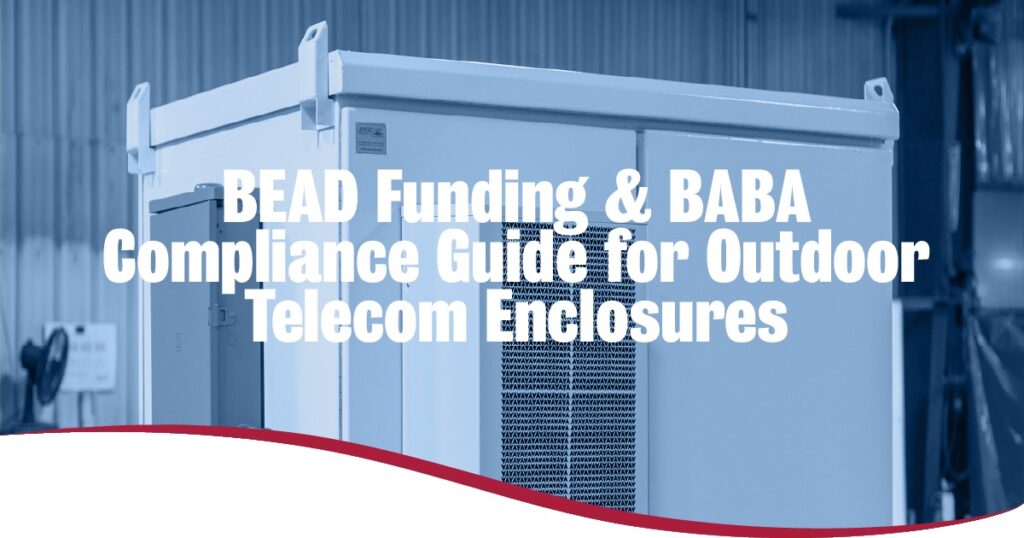
The 2026 BEAD Program Broadband Buildout
The largest broadband investment in U.S. history has moved from planning to execution. $42.45 billion in Broadband Equity, Access, and Deployment (BEAD) Program funding has started flowing from state agencies into active construction schedules, and broadband providers, utilities, cooperatives, and municipalities are racing to break ground — and source the outdoor telecom enclosures to support their projects.
Access to funds isn’t automatic, though.
The Build America, Buy America (BABA) Act governs which projects receive federal reimbursement, and the window to act is narrowing. According to the National Telecommunications & Information Administration (NTIA) BEAD Progress Dashboard, more than 43 states have received final proposal approval, pushing hundreds of projects into procurement and construction.
Project teams must treat enclosure selection as more than an engineering decision. Choosing the right enclosure manufacturer directly affects compliance, funding eligibility, and long-term network performance — and teams that select compliant hardware early reduce risk and keep schedules intact.
American Products has an entire line of U.S.-made, custom-integrated enclosure solutions that provide BEAD-funded projects a clear path forward.
Understanding BABA Compliance Rules for Outdoor Telecom Enclosures
BABA Domestic Content Requirements for Broadband Infrastructure
Under the BEAD program, the BABA Act enforces a Domestic Content Procurement Preference for manufactured products. To qualify for reimbursement, enclosures must meet defined domestic manufacturing and component sourcing requirements. These rules apply directly to cabinets, shelters, and outdoor enclosures that protect critical broadband infrastructure.
BABA requires that at least 55 percent of the total component cost of a manufactured product be sourced domestically, with final manufacturing occurring in the United States.
Project teams cannot evaluate compliance by looking at metal alone, either. Every internal component contributes to the total calculation.
What BABA Compliance Covers in Telecom Enclosures
Modern telecom enclosures function as integrated systems, not empty shells. Therefore, cooling assemblies, power distribution, grounding, cable management, mounting hardware, and monitoring components all affect compliance.
When teams add components in the field or source them from multiple vendors, documentation gaps appear. Those gaps complicate audits and increase the risk of reimbursement delays.
Recent regulatory changes reinforce this risk. In one example, federal agencies rescinded the Federal Highway Administration (FHWA) general waiver, signaling stricter enforcement of domestic requirements for telecommunications and Intelligent Transportation Systems (ITS) projects.
BEAD recipients should expect closer review, stronger documentation requirements, and less tolerance for undocumented foreign content.
Why Custom Integrated Enclosures Matter for BEAD-Funded Projects
Risk Control for BEAD Funding Compliance
Custom-integrated enclosure solutions allow manufacturers to engineer compliance into the product from the start. Instead of modifying empty cabinets after delivery, project managers can specify components, layouts, and systems that meet operational and BABA requirements.
This removes uncertainty and helps mitigate compliance issues after the enclosure is deployed.
Audit Defensibility with BABA-Compliant Enclosures
Factory integration simplifies compliance and makes it easier to prove component and material origin.
By integrating cooling, power distribution, grounding, and cable management in our own manufacturing facility, American Products reduces the number of suppliers involved, creates a single traceable manufacturing record, and simplifies audit documentation.
For BEAD-funded projects, this approach accelerates reviews and reduces the risk of being denied reimbursement.
Future-Proof Broadband Infrastructure with Smart Enclosure Design
Custom integrated enclosures also support advanced network intelligence. Features such as Near Field Communication (NFC) access control, remote environmental monitoring, and thermal management allow networks to scale their infrastructure while continuing to provide reliable connections.
BEAD-funded infrastructure must be designed to operate for decades. Design decisions made today directly affect long-term operating costs and network uptime.
Middle-Mile Infrastructure & FTTP Enclosure Requirements
Middle-mile aggregation sites and fiber-to-the-premises (FTTP) deployments present different operational demands. Custom integrated solutions allow engineers to design enclosures that meet the demands of dense fiber terminations, extreme climates, and space-constrained installations without compromising compliance.
Industry data supports this shift. With the global telecom enclosure market growing at an estimated 8.3% CAGR, demand is also rising for ruggedized, specialized, and compliance-ready enclosures.
U.S.-Made Outdoor Telecom Enclosures Built for BEAD Projects
The AP Fort Shelter
The AP Fort Shelter is a U.S.-made outdoor telecom enclosure purpose-built for large-scale fiber and 5G telecommunications hubs.
American Products builds the Fort Shelter with a galvanized steel structure, NEMA Type 3R protection, and up to R-19 insulation. This ruggedness helps keep componentry working even in extreme climates and high-demand environments.
Project teams rely on the Fort Shelter for middle-mile infrastructure, regional aggregation sites, and 5G wireless backhaul deployments where durability and compliance are non-negotiable.
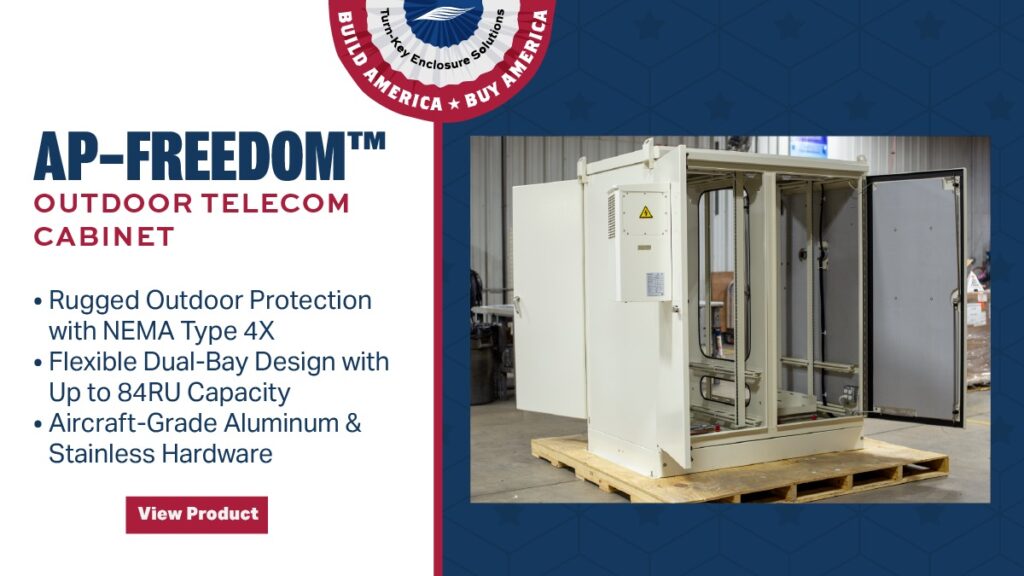
The AP Freedom (Dual Bay)
The dual-bay AP Freedom provides flexibility for distributed fiber deployments without sacrificing performance.
American Products constructs this outdoor fiber optic enclosure from .125 aircraft-grade aluminum and rates it NEMA Type 4X for superior environmental protection. Optional solar shield roofs reduce radiant heat and extend equipment life in exposed locations.
The Freedom Dual Bay supports FTTP deployments where limited space, environmental exposure, and long-term reliability intersect.
Factory Integration Matters
Across the American Products shelter and enclosure lines, factory-integrated cooling, power, and cable management reduce field calls, limit installation variability, and ensure BABA compliance from the source. This lowers deployment risks while improving long-term network performance.
Risk Mitigation: The True Cost of Non-Compliance
Funding & Audit Exposure
When teams deploy non-compliant hardware, they risk delayed reimbursement, extended compliance reviews, and costly corrective actions. In some cases, agencies may require equipment replacement after installation, disrupting schedules and budgets.
Supply Chain Stability
Domestic manufacturing eliminates exposure to international shipping delays, tariff volatility, and waiver uncertainty. In a competitive BEAD environment, reliable lead times keep projects on schedule and costs within budget.
BEAD Funding in Action: Broadband Deployment Demand by State
States such as Alabama, with more than $1.4 billion in BEAD funding, and Tennessee, with over $813 million, are prioritizing large-scale fiber deployments.
These projects require thousands of outdoor enclosures to perform reliably while meeting strict compliance documentation standards. Funded entities are actively selecting vendors that deliver both engineering confidence and audit readiness.
Your Partner in Domestic Excellence
BEAD-funded broadband projects succeed when teams eliminate uncertainty. American Products delivers U.S.-made, custom-integrated enclosure solutions that simplify BABA compliance and support long-term network reliability.
From engineering consultation through documentation support, American Products helps project managers reduce risk, protect reimbursement eligibility, and build broadband infrastructure designed to last.
Explore our BABA-compliant outdoor telecom enclosures and consult with our engineering team to design your BEAD-funded enclosure strategy today.