

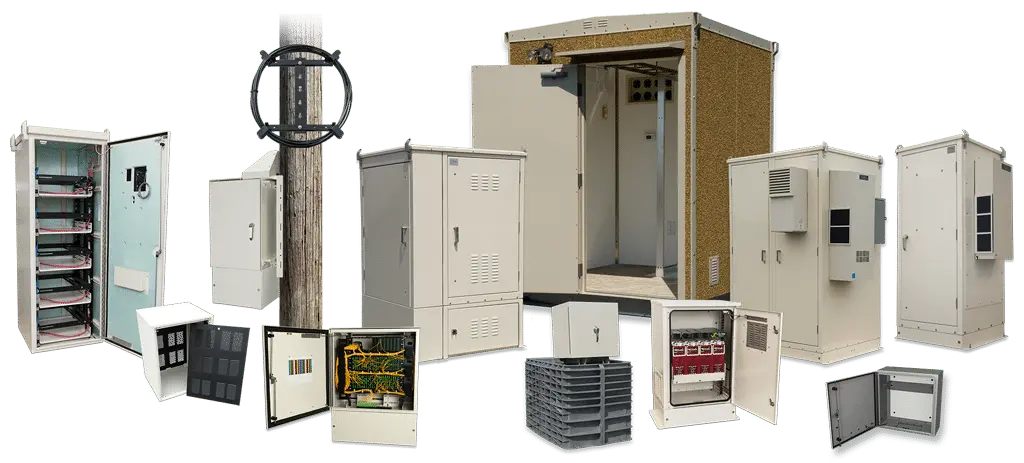
Choosing the right OEM partner for your projects can help you get the most value and use government funding better.
As telecommunications companies prepare to apply for and use Broadband Equity, Access, and Deployment (BEAD) Program funding, it’s key they partner with the right enclosure manufacturer for their project.
Choose the right OEM partner and successfully complete your projects with minimal hitches or surprises and have peace of mind knowing your network is safe and secure.
Choose the wrong OEM, and you could face unexpected delays and cost changes, as well as cabinets that don’t fit your needs and require component integrations or retrofitting in the field to bring it up to your liking.
Let’s look at what you should consider when considering OEMs to ensure you partner with the right enclosure manufacturer.
Things to Consider When Choosing an Enclosure Manufacturer
Overall Value
As BEAD funding is released, every organization that receives it will want to get the absolute most out of the funds. This means key infrastructure pieces, such as your enclosures and the components they house, should add as much value as possible to the project.
One key way of doing that is through factory integration.
This is where the OEM builds/includes all the components they offer, e.g., power systems, batteries. The other option is for the telecom organization to order the standard factory enclosure, and order/add their components separately, either at their facility or in the field.
Many organizations’ biggest issue with factory integration is the upfront cost. The cost of each enclosure will be higher with the components added at the factory than if the enclosures were shipped as a basic, no options-added order. Organizations sometimes think it’s more cost-effective to order a basic cabinet and then order and integrate components separately. This way, they can search for the best deal themselves.
With factory integration, you know all the costs of each component, including installation, upfront. There are no surprises. No technician costs. And instead, your technicians can focus on more value-added duties.
Integrated enclosures also make project logistics much easier. If the company orders components separate from the enclosure, they must track every one of those orders and make sure they all arrive on time. Every component will have its own lead time and shipping method, making tracking them all even more complex. Any single delayed shipment could potentially delay part or all of the project.
This can also require the telecom organization to store the enclosures and components as they await deployment.
Instead, pre-integrated enclosures often come virtually “plug-and-play” ready. Install, hook up the necessary systems and go. No multiple trips to install the cabinet and the components as they come in. No supply chain breakdowns that leave you with an unworking cabinet while you wait for components or a technician to arrive on site.
If a project is wide-ranging across the country and/or involves multiple enclosures, factory integration is even more important for consistency purposes.
When components are integrated at the factory, they are most often done so by trained professionals who do that job regularly and in the same way across all the enclosures. When the telecom organization receives those enclosures-whether it be 5 or 100-every single one will be integrated in the same way. And, a quality OEM will provide documentation of all the components and how to access them.
Down the road, experienced technicians will be able to look at any one of those enclosures and know it is built, outfitted and wired the same as the others they have looked at. If there’s an issue, the technician knows exactly how to trace it and correct it.
When done in the field, the integrations often happen by multiple technicians across the network, each with their own way of doing things. The tech who works on enclosures in one state might install something just a little differently the way a tech in another state does it.
If a technician transfers from one region to another, it could be harder for them to find and trace \issues due to the design differences. If not documented properly, this could be an issue for new team members who don’t have a reference tool for the enclosures they’re expected to service.
A quality enclosure manufacturer will also ensure every single system they install is up to code. No shortcuts or stopgaps. Every component will be installed according to the original manufacturer’s recommendations and in adherence to best practice standards and applicable industry and national codes. They will be able to back up that with documentation.
Manufacturers who build enclosures for networks the nation or the world over will also be more in tune with those codes and can advise the customer according to them.
Experience
Whether you’re a large global network provider or a local one, partnering with an experienced OEM can make the entire process, from ordering to delivery, extremely easy.
An experienced enclosure manufacturer will have many years of experience working with numerous organizations. They have been building enclosures for years, and have adapted and perfected their processes. They often have developed relationships with vendors that help ensure better prices on materials and components.
By working with a variety of network providers and vendors through the years, manufacturers will have insight into new and old technology solutions. They’ve often worked with other providers who have faced similar challenges to your own, and have helped them develop ways to overcome said challenges.
This means that when you go to them, they’ll likely have a solution already available, or the knowledge and team capability to find one.
If you’re building a fiber network, you also want to partner with a manufacturer who understands the ins and outs of fiber and ensuring proper connections. They should be able to test fiber to help mitigate issues when connecting customers.
Trust
Trust is developed over time, but it’s something a good OEM partner will help grow during the period you work with them.
One of the biggest ways a good OEM partner will foster a trusting relationship with you is by being honest. When you’re ordering your cabinet and choosing your accessories (if factory integrated), a trustworthy OEM will advise you on which enclosure style, size and accessories will actually fit your needs. If there’s a conflict, e.g., not enough power for the requested system, they will see that and relay it to the customer, rather than just going forward with the build as is.
Manufacturing
The location(s) of the enclosure manufacturer should also be considered.
For one, if you want an enclosure that complies with the Build America, Buy America (BABA) Act, it must be built within the United States. Some manufacturers use cabinets, components and/or materials that are sourced from a company outside the U.S. Depending on the part and the rest of the cabinet, this could disqualify a project from meeting BABA requirements, hindering funding incentives.
This also affects shipping times and logistics. When components and materials are imported, there are more chances for supply chain failures and delays. It could also be more costly.
Quality partners will also have internal engineering and production teams, which help with communications and responsiveness to questions or changes.
Partners, Not Proxies
In summary, telecom organizations can get the most value out of their BEAD funding by partnering with a quality enclosure manufacturer. This can help reduce overall costs (even if it doesn’t appear so up front), simplify logistics and, ultimately, help ensure a smooth network build.
At American Products, we have decades of experience helping telecommunications of all sizes and from all over the world build out their networks. We have highly-trained in-house engineering and production teams to ensure every enclosure we build will protect your valuable equipment for years to come.
American Products builds every single enclosure solution in our Strafford, MO. Manufacturing facility. We work with other American-based manufacturers to source American-made materials and components when available. This means American Products enclosures will help you meet Build America, Buy America (BABA) Act requirements for funding.
To learn more about American Products enclosure solutions, including how we can help you meet BABA requirements, please contact our enclosure specialists at 417.736.2135.